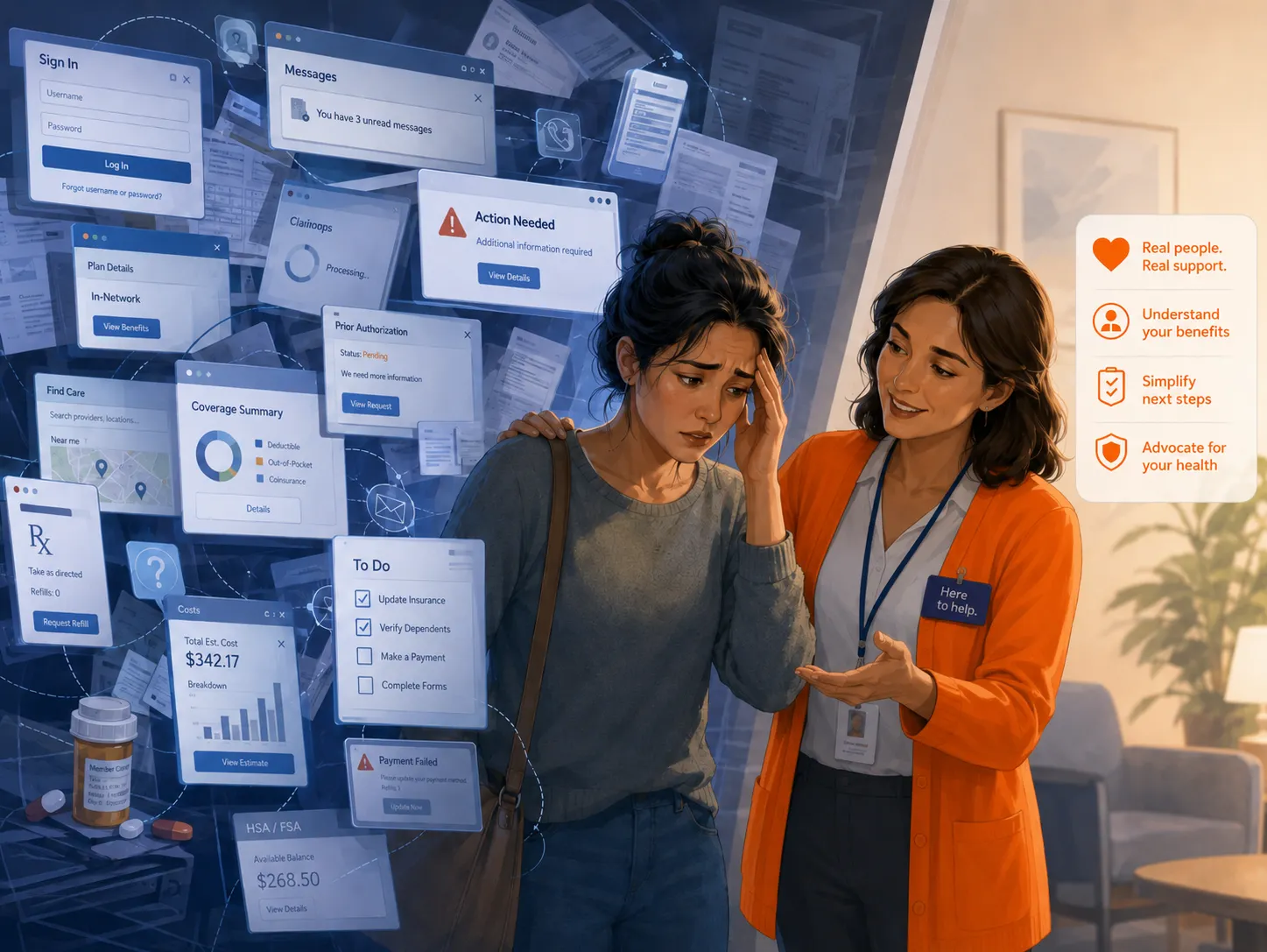
Healthcare keeps trying to solve rising costs with efficiency. More automation. More portals. More ways to move people through the system faster.
And to be fair, some of that matters.
Healthcare is too expensive, too fragmented, and too administratively heavy to pretend technology doesn’t have a role.
But efficiency has a ceiling, because people don’t experience healthcare as a workflow.
They experience it as:
“Is this covered?”
“Why did the price change?”
“Who am I supposed to call?”
“Is this safe?”
“What happens if I mess this up?”
That’s the part the healthcare industry still gets wrong too often.
We’re trying to make the system move faster. But sometimes what people need most is someone willing to slow down and help them through it.
Employers and advisors often see healthcare through data. Through claims reports and utilization. Plan design and savings projections.Those things matter.
A lot.
You can’t manage healthcare costs without understanding what’s driving them. But that’s not how the member experiences the benefit. The member isn’t looking at the spreadsheet. They’re trying to get medication filled.
They’re trying to figure out why pricing has changed, or whether a new process is safe and trustworthy. They’re trying to navigate a system they didn’t design, didn’t ask for, and often don’t understand. And when the medication involved is high-cost, specialty, or clinically important, the stakes feel even higher.
This is where too many healthcare programs fall apart. The strategy is right, the savings are real, the employer truly cares. But the member is left to figure it out alone.
And when that happens, adoption drops.
Frustration rises.
HR gets pulled in.
Brokers get the angry call.
The member loses trust. And the program that was supposed to reduce friction starts creating more of it.
There’s a difference between making something efficient and making something easy.
There’s also a difference between making something easy and making someone feel supported.
A portal can show information. A dashboard can organize data. An automated workflow can trigger the next step. A form can collect what is needed.
But none of those can replace the moment when a member is confused, anxious, or afraid they’re about to make a mistake with a medication they depend on.
When a member is being asked to use a different path for a high-cost medication, they care about more than if the process is efficient. They need to know if it’s real, if it’s safe, if it’s going to delay their therapy. Are they going to get a surprise bill? Is their doctor involved?
Those questions don’t always get answered by another login.
Often people want to ask these questions of another person.
A real person who can explain the process, coordinate with the prescriber, help them understand what needs to happen next. A real person who can follow up when paperwork stalls, who can say, “You’re not in this alone. I’ve got you.”
That’s not always efficient.
One-to-one support in healthcare is often talked about like it is a nice-to-have. A “white glove” feature that sounds good in a finalist meeting but sits off to the side of the actual strategy.
I think that’s backwards.
Concierge support shouldn’t be separate from the strategy. In many cases, concierge support is the mechanism that makes the strategy work. Especially when the program involves patient assistance or alternative pharmacy pathways.
Those strategies can create meaningful savings, but they also require trust, clarity, and follow-through. You can’t just hand a member a set of instructions and hope for the best.
If the member doesn’t understand the process, they don’t use it. If they don’t trust the process, they avoid it. If they get stuck, they give up, and if they give up, the savings never happen.
As an employer, if this is the process you designed, you implemented, and you signed-off on, guess whose fault it is.
So yes, the financial model matters. Yes, the clinical logic matters. Yes, the sourcing strategy matters. But the human support layer is what turns the model into something that actually works in the real world.
For self-funded employers, the goal is to reduce spend, but not at the cost of making life harder for the people using the benefit. That distinction matters. Because a savings program that creates confusion for members is not sustainable.
The best programs reduce both cost and friction. That’s where one-to-one support becomes so important. It turns a complicated process into a guided experience. It gives members someone to trust. It gives HR teams breathing room.
It gives brokers and consultants confidence that the solution won’t become an operational mess. And, it gives the employer a better chance of actually realizing the savings that were modeled in the first place - because savings only matter if the program works in real life.
In healthcare, the member experience can’t be an afterthought - something tacked on after the financial model is built. It has to be part of the strategy from the beginning, because members aren’t line items. They’re people who have to live inside the system we designed.
If it’s too hard, they won’t use it. And if that happens, everyone loses.
Efficiency matters.
But efficiency without support is just a faster way to frustrate people.
Sometimes the answer is not another portal, but a person who knows what the hell is going on and can help someone through it.
At Rescrybe, we help self-funded employers reduce high-cost pharmacy spend through clinical oversight, patient assistance, alternative sourcing when appropriate, and dedicated member support.
Yes, our programs are designed to deliver savings for both employers and their members, but the reason we can deliver on those savings is because of how we support the people inside them.
Our members are guided by dedicated pharmacy technicians who help coordinate the process, answer questions, work through next steps, and keep things moving. That support matters.
It’s why we have 100% client retention.
It’s why we have 98% customer satisfaction.
And, it’s why employers can pursue meaningful pharmacy savings without dumping more work on HR or leaving members to figure it out alone.
Healthcare may be managed in spreadsheets.
But it’s lived by people.
And people need more than another portal.
They need someone who can help.